
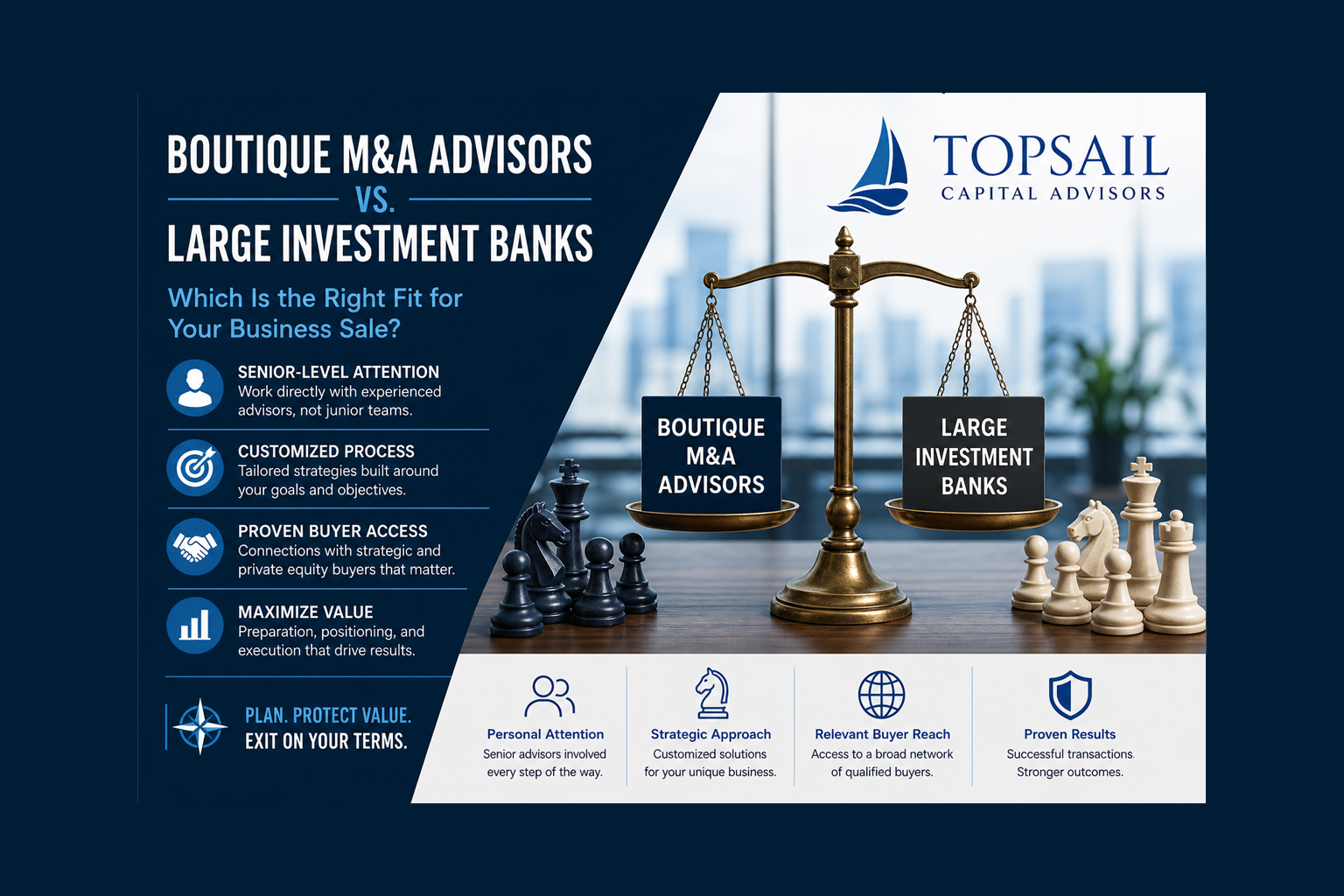
When business owners begin thinking about selling their company, one of the first major decisions they face is choosing the right advisor to guide them through the process.
Should you work with a large institutional investment bank with a global platform and recognizable brand name? Or is a boutique M&A advisory firm a better fit for your transaction?
The answer depends less on size and more on alignment.
At Topsail Capital Advisors, we work primarily with privately held lower middle-market businesses and founder-led companies across the United States. We’ve seen firsthand that for many owners, especially those in the $1MM+ EBITDA range, a boutique advisory model often delivers stronger results through senior-level attention, customized execution, and a more hands-on process.
The right advisor is not simply the biggest—it is the one best equipped to protect value, maximize outcomes, and guide you through one of the most important financial decisions of your life.
What Is the Difference Between a Boutique M&A Advisory Firm and a Large Investment Bank?
Boutique M&A Advisory Firms
Boutique firms like Topsail Capital Advisors typically offer:
-
- Smaller, highly specialized deal teams
-
- Direct involvement from senior advisors throughout the transaction
-
- Flexible and customized processes
-
- Strong focus on founder-led and privately held businesses
-
- Personalized communication and strategic planning
-
- Deeper alignment with ownership goals and exit objectives
These firms are often built around relationships, not volume.
For owners selling a business they’ve spent decades building, that difference matters.
Large Investment Banks
Large institutional investment banks often provide:
- Global buyer networks
- Extensive internal resources
- Larger transaction teams
- Strong brand recognition
- Standardized execution frameworks
- Capital markets integration
- Experience with large-scale and public company transactions
These platforms can be highly effective for billion-dollar transactions, complex cross-border deals, and public company mandates.
But for lower middle-market business owners, those same structures can sometimes create unnecessary layers and less direct senior involvement.
Where Boutique Firms and Large Institutions Are More Similar Than People Think –
Many owners assume that only large investment banks can provide access to quality buyers and sophisticated transaction execution.
That is often not true.
Both boutique advisors and large institutions typically offer:
- Access to strategic buyers and private equity groups
- Full transaction execution from preparation to close
- Industry expertise and sector specialization
- Financial modeling and valuation support
- CIM development and buyer outreach
- Data rooms and diligence management
- Negotiation and closing support
In many middle-market transactions, the actual buyer universe overlaps significantly.
The same private equity firms, strategic acquirers, and capital providers are often evaluating the same opportunities regardless of which advisor brings the deal to market.
The real difference is not access.
It is execution.
Why Founder-Led Businesses Often Choose Boutique M&A Advisors –
For founder-led businesses, selling a company is rarely just a financial transaction.
It is personal.
It is legacy.
It is employees, family, reputation, and decades of sacrifice.
That is why many business owners prefer boutique advisory firms.
1. Direct Senior-Level Attention
At many large firms, senior bankers lead the pitch—but junior teams often manage the day-to-day work.
At Topsail Capital Advisors, senior advisors remain directly involved from valuation through closing.
That consistency matters when major decisions are being made.
You are not handed off.
You work with the same trusted advisors throughout the process.
2. Customized Process Design
No two businesses are the same.
A transportation company in South Carolina is not marketed the same way as a healthcare group in Texas or an industrial manufacturer in Georgia.
Boutique firms build strategy around your specific goals—not a standardized institutional playbook.
That means:
- Better buyer targeting
- Stronger positioning
- More thoughtful timing
- Greater flexibility in negotiation
Your exit strategy should be built for your business—not forced into someone else’s template.
3. Better Alignment with Exit Planning
The best transactions start years before the business goes to market.
At Topsail Capital Advisors, we strongly believe that proper exit planning creates significantly better outcomes.
Understanding value, preparing financials, reducing buyer concerns, and structuring ownership for tax efficiency are all part of maximizing a future exit.
Too many owners wait until revenues decline or life forces a sale.
That is where value gets lost.
What Advantages Do Large Investment Banks Have?
Large institutions absolutely have strengths.
1. Global Buyer Reach
For larger transactions requiring international buyer coverage or institutional capital at scale, large banks can offer broader reach.
This can be particularly valuable in:
- Cross-border transactions
- Public company deals
- Institutional recapitalizations
- Highly specialized sectors
2. Brand Signaling
In some cases, a large bank’s name can create immediate credibility with buyers, lenders, and stakeholders.
This can matter in highly competitive institutional processes.
3. Deep Internal Resources
Larger teams can support:
- Complex financing structures
- Public market transactions
- Large recapitalizations
- Advanced capital markets execution
For the right transaction, those resources are extremely valuable.
The key question is whether your deal actually requires them.
Do Boutique Firms Provide Better Service?
Not automatically.
But in many lower middle-market transactions, yes.
The reason is simple:
Service quality depends on engagement.
Boutique firms often excel because they focus on:
- Active communication
- Fast responsiveness
- Hands-on project management
- Senior accountability
- Strategic flexibility
The distinction is not small versus large.
It is engaged versus detached.
A proactive advisor who communicates clearly and solves problems quickly will almost always outperform a disconnected team with a bigger logo.
Fees: More Similar Than Most Owners Expect
Many owners assume large institutions charge more and boutiques charge less.
In reality, fee structures are often surprisingly similar.
The bigger issue is not headline fees.
It is how your deal is managed.
Ask:
- Who is actually running my transaction?
- Who is accountable when issues arise?
- How often will I speak with senior leadership?
- Is this process designed for my business or their system?
Execution quality—not fee percentage—is what drives outcomes.
The “Right-Sized” M&A Advisor
In our view, the best advisory model is not about being small or large.
It is about being right-sized.
A strong boutique M&A advisor combines:
- Institutional-quality execution
- Senior-level accessibility
- Customized strategy
- Strong buyer coverage
- Flexible process management
That balance is where the best results often happen.
Sophisticated enough to compete.
Personal enough to protect the client.
That is the model we believe in at Topsail Capital Advisors.
Final Thought: Choose the Advisor, Not the Logo
Selling your business is likely one of the largest financial events of your life.
You are not just hiring someone to market your company.
You are choosing who will guide you through valuation, buyer negotiations, due diligence, tax planning discussions, and ultimately the successful transfer of your life’s work.
The question is not:
“Should I hire a boutique firm or a large investment bank?”
The better question is:
“Who is best aligned with my goals and capable of delivering the strongest outcome?”
Because the right advisor should be:
- Present when it matters
- Strategic when decisions get difficult
- Experienced enough to protect value
- Trusted enough to help you make the right call
At Topsail Capital Advisors, we believe owners deserve more than a transaction.
They deserve a strategy.
They deserve preparation.
They deserve an exit on their terms.
On the Lighter Side: When M&A Gets Weird – The Time eBay Bought Skype (and Everyone Asked…Why?)
Not every merger or acquisition is a perfect strategic fit. Sometimes, even billion-dollar deals leave the entire market scratching its head.
One of the most famous “wait… what?” M&A stories was when eBay acquired Skype in September 2005 for approximately $2.6 billion.
At the time, eBay’s logic was that buyers and sellers on the platform would want to jump on voice calls to negotiate deals for used motorcycles, antique furniture, or collectibles.
Sounds reasonable… until you realize most people buying Beanie Babies probably did not want a phone call from a stranger at 10:30 PM asking, “What’s your best price?”
The synergy never really materialized.
Instead of revolutionizing online auctions, users largely ignored the “call the seller” concept, and Skype remained a completely separate business with little connection to eBay’s core operations.
By 2009, eBay sold the majority of Skype at a significant loss. Then, in the ultimate plot twist, Microsoft acquired Skype in 2011 for $8.5 billion.
Translation: eBay paid billions to prove that no one wanted to negotiate baseball card purchases over VoIP.
It remains one of the classic lessons in M&A:
Just because you can force synergy doesn’t mean customers will cooperate.
Sometimes the best diligence question is simply:
“Would anyone actually use this?”
Notable M&A Deals That Happened in May
May has historically been an active month for major transactions. Here are a few memorable ones:
May 1998 — Daimler-Benz + Chrysler Corporation
“Merger of Equals”… Until It Wasn’t
Valued at approximately $36 billion, this was pitched as a “merger of equals,” though many Chrysler executives later joked it felt more like an acquisition with better PR.
Cultural clashes between German engineering precision and Detroit corporate style made integration difficult, and the deal became a case study in how culture can kill value faster than spreadsheets can create it.
May 2013 — Yahoo! Acquires Tumblr
For $1.1 billion, Yahoo! bought Tumblr with the famous promise:
“We promise not to screw it up.”
History suggests… they may have screwed it up.
The platform struggled to monetize, and Yahoo later wrote down most of the acquisition’s value.
A reminder that sometimes the most dangerous words in M&A are:
“Trust us.”
May 2017 — Amazon Announces Acquisition of Whole Foods Market
This $13.7 billion deal shocked both retail and grocery sectors.
Wall Street immediately realized Amazon wasn’t just selling books and batteries anymore—it was coming for avocados too.
It changed expectations for grocery delivery, pricing strategy, and retail convenience nationwide.
May 2022 — Broadcom Inc. Announces Acquisition of VMware
At approximately $61 billion, this became one of the largest tech acquisitions ever.
It also proved that enterprise software may not be flashy—but it definitely writes very large checks.
About Topsail Capital Advisors –
Topsail Capital Advisors is a leading business merger & acquisition advisory firm focused on privately held lower middle-market companies across the United States. We specialize in comprehensive sell-side advisory, market valuation, exit planning, acquisition advisory, and strategic transaction execution across industries including transportation & logistics, industrials, manufacturing, medical, construction materials, and business services.
Our mission is simple:
Plan. Protect Value. Exit on Your Terms.